
June 2026
A Best-of-Breed Chain for AI-Assisted Software Development
Why the hard part of vibe coding is verification, not generation, and how Claude Code, GitHub, Vercel, Next.js and Postgres close the loop we build the Nashua 360 platform on
Abstract
A capable coding agent changes the economics of software development: writing code, the activity that used to dominate a developer’s day, becomes fast and nearly free, while the activities around it, deciding what to build and making sure the result is correct, do not. The constraint moves from generation to verification. This paper argues that the value of an AI-assisted development setup lies not in the model that writes the code but in the chain of tools around it that lets a team verify, at speed, what the agent produces, and that catches its mistakes before they reach users. It is a technical, opinionated account of the chain we at Nashua build and run our own product, the Nashua 360 Enterprise Platform, on, and of why each link is what it is: Claude Code as the agent, run in a loop with the rest of the chain and reachable from a mobile app so that a change can be started and a result reviewed from a phone; GitHub as the spine, with a protected main branch, required status checks, and a pull request as the unit of change; Vercel giving every pull request its own isolated, running preview deployment; Next.js as a typed, conventional framework whose type checker is the first and cheapest gate and whose rendering and runtime model the agent navigates fluently; and PostgreSQL as durable state, changed through reviewed, reversible migrations. We go into the parts practitioners care about: how the agent is given context and kept honest, what runs in continuous integration, what a preview deployment actually is, how Next.js renders and where it runs, and how to change a live database without breaking it. We argue that for AI-assisted work best-of-breed means conventional, because the agent writes the tools it has seen most, best, and we are candid about the costs: vendor coupling, the discipline the human review gate demands, the risk of an agent with broad access, and the irreversibility of data. This is practitioner-facing advice, not a benchmark.
Keywords: AI-assisted development; vibe coding; coding agents; Claude Code; GitHub; Vercel; Next.js; PostgreSQL; continuous delivery; preview deployments; code review; database migrations; developer tooling; Nashua 360
1. Introduction
For most of the history of software, the scarce resource was the writing. A developer’s craft was measured in the ability to turn an intention into correct code, and the hours went into typing, looking things up, wiring libraries together, fixing the small mistakes that compile errors and failing tests revealed. A capable coding agent removes most of that. Give it a clear instruction and access to a codebase and it will produce a working change in minutes, in idioms it has seen a million times, with the boilerplate already correct. The colloquial name for working this way, popularised in early 2025, is vibe coding: describing what you want and letting the model produce it, steering by results rather than by writing each line. It is genuinely a step change, and it is easy to mistake it for the whole story.
It is not the whole story, because making code appear was never the hard part of software, only the laborious part. The hard parts are deciding what to build, and knowing that what was built is actually right, secure and fit to run. These do not get cheaper when generation does; if anything they get harder, because there is now far more code to understand, produced faster than a person wrote it, by an author who is confident even when wrong. The bottleneck of software development moves. It used to sit at generation, how fast a team could write correct code. With an agent it sits at verification: how fast a team can be sure the code is correct and let it through.
This paper is about the consequence of that shift for tooling, and it is deliberately concrete. If verification is the constraint, then the most valuable thing an AI-assisted setup can do is not generate faster, it is to help a team verify faster and more safely, catching the agent’s mistakes cheaply and early. We describe the specific chain we at Nashua use to build and operate our own product, the Nashua 360 Enterprise Platform, Claude Code as the agent, GitHub as the version-controlled spine and review gate, Vercel for a running preview of every change, Next.js as the application framework, and Postgres as the database, and we go into how each piece actually works, because the detail is where the value is. Each link earns its place by tightening a loop or adding a gate, not by being individually clever.
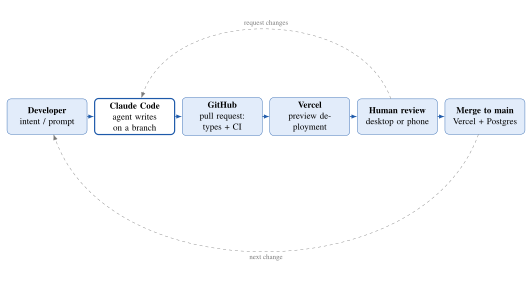
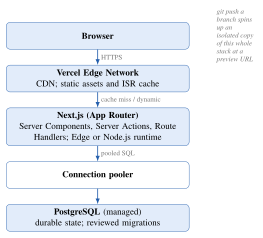
The contribution is an argument and a worked recommendation, not a benchmark. Section 2 sets out what AI changed and what it did not, and locates the bottleneck. Section 3 presents the chain as a loop (Figure 1), makes the case that for agent-assisted work best-of-breed means conventional, and explains why independent gates compound. Sections 4 to 9 take the five pieces in turn and go into their internals, including the runtime architecture a deployment actually has (Figure 2) and the part that surprises people, that a change can now be started and reviewed from a phone. Sections 10 to 12 treat the human gate and its failure modes, the real costs, and how the chain runs in practice. The question throughout is: once an agent can write the code, what should a team put around it so that writing fast does not mean shipping wrong?
2. What AI changed, and what it did not
2.1 The shift
The change an agent brings is best stated precisely. It is not that the machine now understands the problem; it is that the cost of producing a plausible, often correct, implementation of a well-specified change has collapsed. A developer who would have spent an afternoon on a feature can have a first version in the time it takes to describe it, and can throw several versions away cheaply. The mode of work shifts from authoring to directing: stating intent, reading results, correcting course. This is real leverage, and a team that refuses it will be outpaced.
2.2 No silver bullet
The change is also bounded, and the bound is old. Brooks (1987) drew the distinction that still governs here: the accidental complexity of software, the labour imposed by our tools and languages rather than by the problem, can be attacked and reduced, but the essential complexity, understanding the problem and specifying a correct solution, cannot be automated away, because it is the problem. A coding agent is the most powerful attack on accidental complexity yet built: it absorbs the syntax, the boilerplate, the API lookups, the idioms. It does nothing about the essence. Knowing what the business needs, deciding the right design, and establishing that a given change actually meets the need without breaking something else, remain human work, and they are the work that was always hard.
2.3 Verification becomes the constraint
Put the two together and the conclusion follows. Generation, the accidental part, is now fast and cheap. Verification, which is where the essence lives, that this change is correct, that it does what was wanted, that it has not broken anything, that it is safe to expose, is not. In any pipeline the throughput is set by the slowest stage, and when generation accelerates past verification, verification becomes the binding constraint. A team that can generate ten changes a day but verify two will ship two, and will accumulate a backlog of unverified code that is a liability, not an asset. Worse, an agent produces confident, superficially correct work, so the cost of under-verifying, of merging what looks right and is not, rises exactly as the temptation to do so rises. The rest of this paper is about building a chain whose job is to raise the verification ceiling and to make under-verification hard.
3. The chain, and why conventional wins
3.1 The loop
A good AI-assisted setup is a loop, not a tool. Figure 1 draws the one we use. A developer states an intent. Claude Code, the agent, turns it into a change on a branch, not on the live code. The change becomes a GitHub pull request, where two automated gates run without anyone’s attention: the type checker and the continuous-integration suite. Vercel builds the branch into a real, running preview deployment, a full copy of the application with the change live, reachable at its own URL. A human reviews the change, reading the diff and clicking through the preview, on a desktop or, increasingly, on a phone. Only then is it merged to the main branch, which Vercel deploys to production, backed by Postgres. The outcome feeds the next intent. The point of the diagram is that the agent occupies one box; every other box is a loop closing or a gate catching, and that is where the safety and the speed come from.
3.2 Best-of-breed means conventional
The usual way to choose tools is to rank them by power and pick the most capable. For an agent-assisted chain the criterion is different, and it is the single most useful idea in this paper. An agent writes the tools it has seen most, best. Its competence on a framework or a database is a function of how much correct code using that tool was in its training, and that quantity tracks the tool’s popularity, its documentation, and the stability of its conventions. A mainstream, well-documented, convention-heavy tool is therefore not just a safe human choice; it is the choice on which the agent is most capable and least likely to invent an API that does not exist. The effect compounds: popular tools get more agent-generated code, which works, which reinforces their popularity. For AI-assisted development, best-of-breed and most-conventional have converged, and every tool in Table 1 was chosen with that in mind. This is also a warning: the exotic framework a human expert could wield brilliantly is often exactly where an agent is weakest, because it has seen the least of it.
3.3 Why independent gates compound
The chain does not trust any one check. It verifies a change through several gates that look at genuinely different things: the type checker checks shapes, the continuous-integration tests check behaviour, the preview deployment shows the running result, and the human reviewer judges intent. Because the gates are largely independent, their misses multiply rather than add: a defect reaches production only if every gate fails to catch it, so four modest gates that each catch most of what they see let through only a small fraction of the product of what they miss. This is the defence-in-depth principle long known in safety engineering as the layering of imperfect barriers (Reason, 2000), and it has a sharp practical corollary. Removing or weakening one gate, skipping the preview, turning off a strict type, approving without reading, does not add a little risk; it multiplies the escape rate by the reciprocal of what that gate used to catch. The cheapest way to stay safe is to keep several different, imperfect gates honest, which is exactly what the chain is arranged to do.
Table 1. The chain. Each link is chosen for the loop it closes or the gate it adds, and for being conventional enough that the agent handles it well. The last column names what the link mainly protects against.
| Link | What we use | Loop it closes or gate it adds | What it guards against |
|---|---|---|---|
| Coding agent | Claude Code (CLI, cloud and mobile) | Turns intent into a change on a branch; runs checks and tests itself before handing over | A human doing the accidental work by hand; slow iteration |
| Source control and review | GitHub (branches, pull requests, Actions) | Every change is a reviewable diff; nothing reaches the main branch unreviewed; CI runs on each | Unreviewed change reaching production; lost history; no audit trail |
| Preview and deployment | Vercel (git-connected) | An isolated, running preview of every pull request at its own URL; one-click production deploy and rollback | Reviewing code you cannot see run; risky releases |
| Web framework | Next.js (TypeScript) | Types as the first automatic gate; conventional, file-based structure the agent navigates well | Whole classes of defect the type checker rejects; the agent getting lost |
| Database | PostgreSQL (managed) | Durable, transactional state with reviewed, versioned migrations | Data loss; silent schema drift; unrepeatable environments |
| Human review gate | A person, at the pull request | The judgement no gate automates: is this what we wanted, and is it safe? | Confidently wrong code that passed every automatic check |
4. The agent: how Claude Code fits
Claude Code is the agent: a tool that reads the codebase, writes and edits files, runs commands, executes the tests, and opens pull requests, working from an instruction and correcting itself against the results it sees. How it is run matters more than the model’s raw ability, and three things about it are worth a practitioner’s attention.
The first is context. An agent is only as good as what it knows about your codebase, and the single highest-leverage artefact is a checked-in conventions file, in our case a project CLAUDE.md, that tells the agent the house rules: how the project is laid out, how to run the type checker and tests, what to deploy and how, what never to touch. The agent reads it on every run, so a correction written down once stops recurring. Around it sits a wider surface, reusable skills for repeated tasks, hooks that run on tool calls to enforce a rule mechanically, and MCP servers that give the agent typed access to outside systems, GitHub among them, so it can open and update pull requests as first-class actions rather than by screen-scraping. Context engineering, deciding what the agent should know and be able to do, is the real work of adopting one, and it is ordinary software hygiene: write the conventions down, make the checks runnable, keep the surface small.
The second is that the agent runs in the loop rather than in isolation. It is expected to run the type checker and the tests itself, read what they report, and fix it, before any human looks, so that the automatic gates of the chain are already green by the time a pull request is opened. For larger tasks it can fan work out to subagents that each carry their own context and report back, which keeps the main thread focused and the context clean. The discipline is to let the fast, cheap feedback, types and tests, happen inside the agent’s own loop, and to reserve the slow, expensive feedback, the human, for the end.
The third is where it runs. Beyond the terminal, Claude Code runs as a cloud session reachable from a mobile app, which changes the shape of the working day. A change can be started from a phone on the way somewhere, left to run in the cloud, and its pull request and preview reviewed and approved from the same phone later. We are deliberate about this not because mobile work is a novelty but because it shortens the loop: the gap between noticing something and starting the change, and between a change being ready and someone approving it, collapses from hours to minutes, which in a verification-bound world is exactly the gap worth closing.
5. The spine: GitHub
GitHub is the part of the chain that makes everything else safe, and it is the least glamorous. It holds the single source of truth, the repository, and it enforces the rule on which the whole argument rests: the main branch, the one that ships, is protected, and can be reached only through a pull request that a human has approved and whose required status checks have passed. The agent never edits production code directly; it proposes, on a branch, and the proposal is a diff a human can read and a machine can test.
The required checks are where the automatic gates live. On every pull request, GitHub Actions runs the suite we insist on before anything merges: the type checker, the linter, the test suite, and a production build, each a required status that blocks the merge button until it is green. Because these are enforced by the platform rather than by anyone’s discipline, they cannot be skipped in a hurry, and because the agent knows they will run, it satisfies them first. The pull request is the unit of change: small, self-contained, individually reviewable and individually revertible, which is what keeps review cheap and history legible. And because every change is a commit with an author and a message, the history is an audit trail and the undo is total, anything the agent did can be seen, attributed and reverted. A coding agent is a fast, powerful and fallible actor, and GitHub is the structure that makes it safe to let one loose, by ensuring nothing it does is unreviewed, untested or irreversible.
6. The eyes: Vercel
Reading a diff tells you what changed; it does not tell you what the change does. Vercel closes that gap by building every pull request into a preview deployment: a complete, isolated, running instance of the application with the change applied, at its own URL, created automatically and updated on every push. This is the gate that catches what types and tests do not, the layout that broke, the flow that got one step longer, the thing that is technically correct and wrong in use, and it is most of why the chain can move fast without moving blind. A reviewer, and the agent, click through the actual result rather than imagining it from the code.
What makes the preview trustworthy is that it is a real build of the whole stack, not a mock (Figure 2): the same framework, the same runtime, its own environment variables, and, done well, its own isolated or branched database so that exercising it cannot touch production data. Deployments are immutable: each is a distinct, addressable build, so promoting a reviewed preview to production is a pointer move rather than a rebuild, and a bad release is an instant rollback to the previous immutable deployment rather than a frantic hotfix. On merge to the main branch the same machinery that built the preview builds production, so the thing that was reviewed is the thing that ships. In the model of this chain, preview deployments are a cheap, automatic verification gate with a high catch rate for a class of defect no other gate sees.
7. Seamless by git: why the three fit together
The reason Claude Code, GitHub and Vercel feel less like three tools and more like one system is that they share a single interface, and that interface is git. Claude Code’s natural output is not a deployment; it is a branch and a pull request. GitHub’s job is to store those commits, run the checks and hold the review. Vercel watches the repository and turns every branch into a preview and the main branch into production. None of them had to be taught about the others: the agent never learns a deployment API, it opens a pull request; Vercel never learns about the agent, it watches the repo. The seam between them is the git protocol all three already speak, which is why adding an agent to the chain changed nothing about how deployment worked, and why the whole path from a prompt to production has no handoffs in it.
The consequence is that deployment stops being a step anyone performs and becomes a consequence of the git action they were going to take anyway. A push is a build. A pull request is a preview environment, created and torn down on its own. A merge to the main branch is a production deploy. A revert is a rollback. Nobody runs a release; they merge, and the release happens. There is no build server to babysit, no deploy script for the agent to get wrong, no separate promotion tool, no window in which someone has written the code but not yet shipped it. For a verification-bound team this is exactly the right place to remove friction: the only deliberate, human act left in the path is the review, which is the one act that should be deliberate, and everything mechanical around it is handled by the tools watching git.
This is also why the seamlessness is safe rather than reckless, and the two properties come from the same fact. Because deployment rides on git, it inherits git’s guarantees: every production deploy is tied to a specific reviewed commit, with an author and a message; every preview is tied to a branch; and because deployments are immutable, rolling back is just pointing production at an earlier commit’s build. The same wiring that lets a change flow from a phone-typed prompt to a live site without anyone touching a deploy console also ensures that nothing reaches that live site except through a reviewed, attributable, revertible commit. The integration is a match not because the vendors coordinated it but because all three were built to treat git as the source of truth, and when the agent joined that convention, the pipeline it needed was already there.
8. The terrain: Next.js
The agent has to navigate a codebase, and the codebase’s framework is the terrain. Next.js is a strong choice for two reasons that both come back to verification. The first is that it is TypeScript, and types are the first and cheapest gate. Run in strict mode, the type checker rejects a large class of mistake, a wrong shape, a missing field, a value that might be null, at the moment the agent writes it, which is exactly when a correction is cheapest, before the code runs and long before a human looks. We push the same idea to the program’s edges, validating external input, request bodies, environment variables, database rows, against a schema so that untyped data from outside becomes typed and checked at the boundary rather than trusted. Types are not bureaucracy here; they are the gate that turns the agent’s most common error, a plausible shape that is subtly wrong, into a red squiggle it fixes itself.
The second reason is that Next.js is conventional, and its model, though rich, is well-trodden enough that the agent writes it fluently. It is worth being concrete about that model, because it is where a lot of the engineering lives. The App Router renders on the server by default: Server Components run on the server and never ship their code to the browser, keeping data access and secrets server-side, while Client Components, marked explicitly, carry the interactivity. Mutations go through Server Actions, server functions a form or a button can call directly, and Route Handlers provide the API surface. Each route chooses how it renders, static at build time, incrementally regenerated on a schedule, or dynamically per request, and where it runs, the lightweight Edge runtime close to the user or the fuller Node.js runtime, with middleware running before the request to handle things like authentication and locale. These are a lot of levers, but they are public, documented, stable levers the agent has seen used correctly at scale, so it reaches for the right one, and the framework is powerful enough to build a real product while remaining the terrain on which the agent is most capable, which, by the argument of Section 3, is the combination that matters.
9. The state: Postgres
Everything above concerns code, which is safe to change because it is versioned and reversible. Data is not: a dropped column or a bad migration can destroy something no commit can restore. Postgres is the durable, transactional state at the bottom of the chain, and the discipline around it is deliberately stricter than around code. PostgreSQL earns its place the same way the rest of the chain does, it is the conventional, battle-tested, superbly documented choice, so the agent writes correct SQL and correct migrations against it, and a managed instance removes the operational toil without changing the model.
The care goes into change. Schema changes are migrations: ordered, versioned files checked into the repository and reviewed like any other change, run against the preview before production, and written to be reversible. A live database cannot be changed the way a fresh one can, so a risky change is made as a sequence of safe ones, the expand and contract pattern (Ambler & Sadalage, 2006): add the new column or table and start writing to it, backfill, move reads across, and only then, in a later deployment, remove the old shape, so that at every intermediate step the running code and the schema are compatible and the step is reversible. Postgres helps by making most schema changes transactional, so a failed migration rolls back cleanly rather than leaving the database half-changed. Two operational points matter in a serverless setting, where many short-lived function instances each want a connection: a connection pooler is not optional, because a database has a hard connection limit that a fleet of serverless workers will otherwise exhaust; and row-level security lets the database itself enforce who may see which rows, a backstop that does not depend on the application getting every query right. The rule we keep is simple and worth stating: the agent may propose a migration, but a migration is the one kind of change a human always reads with full attention, because it is the one kind the chain cannot fully undo.
10. The human gate and how it fails
Every automatic gate in this chain exists to make the human gate cheap, not to remove it. The reviewer at the pull request does the one thing no gate automates: judging whether the change is what the business actually wanted and whether it is safe to expose, questions that types, tests and previews inform but do not answer. The chain’s whole purpose is to deliver that reviewer a small, running, pre-checked change so that the judgement is quick and well-founded. But the gate has characteristic failure modes, and naming them is part of using the chain well.
The first is rubber-stamping. When the agent is usually right, the reviewer learns to approve quickly, and the review degrades into a formality that catches nothing. The defence is to keep changes small, so that reading them properly stays cheap, and to treat the preview as mandatory, not optional: a review that did not click through the running change is not a review. The second is over-trust, the belief that because the code passed the type checker and the tests it must be correct; those gates catch shapes and behaviours but not intent, and the human is the only gate on intent. The third is scale fatigue: an agent can open more pull requests than a team can seriously review, and a backlog of half-reviewed changes is the verification-bound regime reasserting itself. The answer is not to review faster but to generate more deliberately, to let the agent produce only what the team can actually verify, because unverified change is a liability whatever its volume.
11. Costs and trade-offs
The chain is a set of choices, and honesty requires stating what they cost. The most obvious is coupling: Next.js and Vercel come from the same company, and building on them buys a smooth, integrated path at the price of a degree of lock-in, both to a framework that moves quickly and sometimes breaks compatibility between major versions, and to a hosting platform whose pricing and primitives you adopt. We judge the trade worth it for the velocity and the quality of the preview loop, but it is a real dependency, and a team should keep its domain logic and its data portable so that the framework and host remain replaceable infrastructure rather than the product. The second cost is the discipline the gate demands: the chain is only as safe as the review it culminates in, and a team that lets the human gate decay to rubber-stamping has a fast way to ship confident mistakes, which is worse than a slow way to ship considered ones. The third is the agent’s access: a tool that can edit the repository and trigger deployments is a powerful actor, and it must be scoped like one, with branch protection, with least-privilege credentials, with secrets kept out of the repository and out of the agent’s reach, and with permission and infrastructure changes reviewed with particular care. The fourth is the irreversibility of data, treated above: the one place the chain’s safety net has a hole, and the place to spend the most human attention. None of these is a reason not to adopt the chain; each is a reason to adopt it deliberately.
12. How we run the Nashua 360 platform on it
The chain in this paper is not a proposal we have theorised; it is the one we build and operate our own product on. The Nashua 360 Enterprise Platform is a Next.js application, deployed on Vercel, backed by Postgres, with its source on GitHub, and it is developed with Claude Code as the agent, including from the mobile app when a change is better started or approved away from a desk. A checked-in conventions file tells the agent the house rules; every change to the platform is a branch and a pull request; every pull request gets its type check, its continuous-integration run, and its preview deployment on an isolated copy of the stack; nothing reaches the production branch without a human reading the diff and clicking through the preview; and migrations are the changes we read hardest. We did not assemble this chain to be fashionable. We assembled it because, once we accepted that an agent had made generation cheap and verification the constraint, every link followed from the question of how to verify fast and safely, and because the same reasoning that makes it right for us, conventional tools the agent handles well, wrapped in loops and gates that catch its mistakes, makes it right for most teams building web software today. That it also lets a serious product be advanced from a phone on a train is not the reason we chose it, but it is a fair sign of how far the shape of the work has changed.
13. Objections and replies
This is just continuous delivery with an agent bolted on. In large part, deliberately. The practices the chain rests on, version control, small reviewed changes, continuous integration, automated deployment with previews and rollback, are the established discipline of modern software delivery (Humble & Farley, 2010; Forsgren et al., 2018), and that is the point: the agent does not replace that discipline, it raises the premium on it, because it is the discipline that supplies the verification the agent’s speed now demands. The contribution is not a new practice but the argument for why the old practices matter more, not less, once generation is cheap.
A better model will make the tooling unnecessary. It will not, because the tooling addresses the part a better model does not touch. A more capable agent generates faster and, in a verification-bound world, generating faster does not raise what actually ships; only verifying faster does. The better model also produces more code, faster, for a human to check, which makes the gates more necessary, not less. The chain is a bet on verification, and that bet gets better, not worse, as generation improves.
You are locked into one vendor’s stack. Partly, and we said so. The coupling of Next.js and Vercel is a real cost accepted for a real benefit, the integrated preview loop that is central to the whole argument. The mitigation is to keep the essential logic, the domain code and the database, portable, and to treat the framework and host as replaceable infrastructure. A team with a different risk appetite can keep the shape of the chain, agent, version control, isolated preview, typed framework, reviewed database, on other components.
14. Limitations
This is practitioner-facing advice, and its limits should be stated. It is a reasoned recommendation grounded in our own use, not a controlled comparison; we have not measured the chain against alternatives. The specific tools are current as of late 2026, and this is a fast-moving field: the argument, that verification is the constraint and that the chain should be read as loops and gates, is meant to outlast any particular tool, but the particular tools will change, and a reader should keep the argument and re-examine the parts. The recommendation is scoped to the kind of software we build, web applications with a database, and carries less directly to domains with different constraints, such as systems where the cost of a verification gate is itself prohibitive, or where no agent has seen enough of the stack to be trusted on it. And the chain’s safety rests on a human gate that the chain makes cheap but cannot make automatic; a team unwilling to keep that gate honest should expect the speed without the safety.
15. Conclusion
A coding agent makes writing software fast, and in doing so moves the hard part into the open. Generation, the part that used to dominate the day, becomes cheap; verification, deciding what to build and being sure the result is right, does not, and becomes the constraint. The lesson for tooling is that the value of an AI-assisted setup is not in the agent but in the chain around it that lets a team verify at the speed the agent generates and catches its mistakes before users do. We build and run the Nashua 360 platform on such a chain: Claude Code to write, in a loop with the checks and reachable from a phone; GitHub to make every change a reviewed, reversible diff behind a protected branch; Vercel to give every change its own running preview and every release an instant rollback; Next.js as a typed, conventional terrain whose types are the first gate; and Postgres as durable state changed through reviewed, reversible migrations. Each link closes a loop or adds a gate, the gates are independent so that no one of them must be perfect, and the whole is chosen on a criterion particular to this moment: that for an agent, the conventional tool is the capable one. Write fast, verify faster, and let nothing reach production that a person has not seen running. That is the whole of it, and it is enough.
Appendix A. An adoption checklist
The practices below are what make the chain safe rather than merely fast. None is novel; the discipline is the value.
Table 2. An adoption checklist. Each practice keeps a gate honest or a loop short; the right-hand column is the failure it prevents.
| Practice | What it prevents |
|---|---|
| Protect the main branch; merge only via reviewed pull request with required checks | Unreviewed or untested change reaching production |
| Keep a checked-in conventions file for the agent | Repeating the same corrections; context drift |
| Keep changes small | Review degrading into rubber-stamping |
| Make the agent run types and tests before handing over | A human doing the machine’s verification |
| Treat the preview as mandatory in review | Approving code nobody saw running |
| Give previews isolated data | A review touching production data |
| Read every migration with full attention; expand then contract | The one change the chain cannot undo |
| Keep secrets out of the repository and the agent’s reach; least privilege | A powerful actor with credentials it does not need |
| Generate only what you can verify | A backlog of unverified, liable change |
References
Ambler, S. W., & Sadalage, P. J. (2006). Refactoring databases: Evolutionary database design. Addison-Wesley. ISBN 978-0-321-29353-5.
Bacchelli, A., & Bird, C. (2013). Expectations, outcomes, and challenges of modern code review. In Proceedings of the 35th International Conference on Software Engineering (ICSE) (pp. 712–721). IEEE. https://doi.org/10.1109/ICSE.2013.6606617
Beck, K. (2000). Extreme programming explained: Embrace change. Addison-Wesley. ISBN 978-0-201-61641-5.
Brooks, F. P. (1987). No silver bullet: Essence and accidents of software engineering. Computer, 20(4), 10–19. https://doi.org/10.1109/MC.1987.1663532
Chen, M., Tworek, J., Jun, H., et al. (2021). Evaluating large language models trained on code. arXiv preprint arXiv:2107.03374. https://arxiv.org/abs/2107.03374
Anthropic (2026). Claude Code documentation. https://code.claude.com/docs
Forsgren, N., Humble, J., & Kim, G. (2018). Accelerate: The science of lean software and DevOps: Building and scaling high performing technology organizations. IT Revolution Press. ISBN 978-1-942788-33-1.
Fowler, M. (2006). Continuous integration. martinfowler.com. https://martinfowler.com/articles/continuousIntegration.html
GitHub (2026). GitHub documentation. https://docs.github.com
Humble, J., & Farley, D. (2010). Continuous delivery: Reliable software releases through build, test, and deployment automation. Addison-Wesley. ISBN 978-0-321-60191-9.
Vercel (2026). Next.js documentation. https://nextjs.org/docs
Peng, S., Kalliamvakou, E., Cihon, P., & Demirer, M. (2023). The impact of AI on developer productivity: Evidence from GitHub Copilot. arXiv preprint arXiv:2302.06590. https://arxiv.org/abs/2302.06590
PostgreSQL Global Development Group (2026). PostgreSQL documentation. https://www.postgresql.org/docs/
Reason, J. (2000). Human error: Models and management. BMJ, 320(7237), 768–770. https://doi.org/10.1136/bmj.320.7237.768
Sadowski, C., Söderberg, E., Church, L., Sipko, M., & Bacchelli, A. (2018). Modern code review: A case study at Google. In Proceedings of the 40th International Conference on Software Engineering: Software Engineering in Practice (ICSE-SEIP) (pp. 181–190). ACM. https://doi.org/10.1145/3183519.3183525
Vercel (2026). Vercel documentation. https://vercel.com/docs